


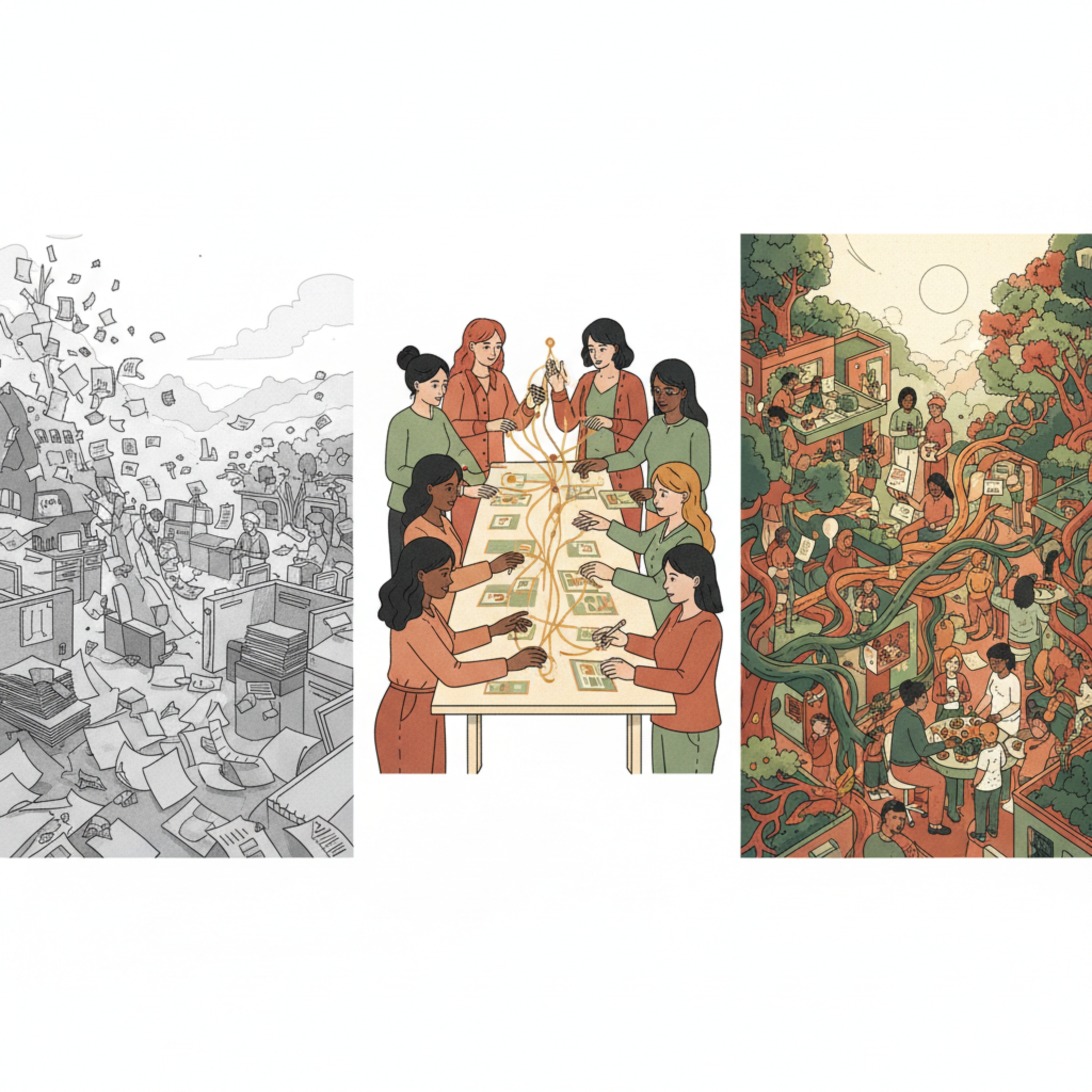
The traditional model of full-time, lifelong employment is a relic of the past. The reality is simple: there are no longer enough secure, meaningful jobs with a genuine future. At the same time, systemic pressures are compounding rapidly. Climate breakdown, resource scarcity, geopolitical conflicts, and AI-driven displacement are accelerating a fundamental shift in how we live and work.
Yet, when people turn to official channels for support, they are funneled into top-down, government-mandated "welfare-to-work" and retraining programs. These rigid, bureaucratic schemes are completely out of touch with today's economic realities. Instead of equipping jobseekers, freelancers, and care workers with tools for a changing world, they produce burnout and deep frustration. Millions in public funding are wasted on outdated compliance exercises rather than genuine empowerment. Because these state structures are top-down, inflexible, and fundamentally undemocratic, they leave people feeling powerless—directly fueling political alienation and the rise of right-wing populism.
High-level discussions around the "Wellbeing Economy," "Post-Growth," and "Common Good Economics" remain trapped in academic ivory towers. The practical, everyday infrastructure needed to make these concepts work for real people simply doesn't exist yet.
Taking Action: The Leipzig Lab for the New Economy
Rather than waiting for slow, top-down state machinery to reform itself, we are building the alternative from the ground up. As an interdisciplinary collective, we are currently forming the first women-owned, common-good cooperative in Eastern Germany. Through the Leipzig Real-World Lab for the New Economy, we are translating academic transformation theories into concrete, battle-tested tools for daily life.
Co-created alongside care workers, freelancers, single parents, and displaced workers, our practical framework focuses on three core pillars:
We are replacing outdated bureaucratic compliance with genuine self-determination, collective resilience, and an economy built on human dignity.
The traditional model of full-time, lifelong employment is a relic of the past. The reality is simple: there are no longer enough secure, meaningful jobs with a genuine future. At the same time, systemic pressures are compounding rapidly. Climate breakdown, resource scarcity, geopolitical conflicts, and AI-driven displacement are accelerating a fundamental shift in how we live and work.
Yet, when people turn to official channels for support, they are funneled into top-down, government-mandated "welfare-to-work" and retraining programs. These rigid, bureaucratic schemes are completely out of touch with today's economic realities. Instead of equipping jobseekers, freelancers, and care workers with tools for a changing world, they produce burnout and deep frustration. Millions in public funding are wasted on outdated compliance exercises rather than genuine empowerment. Because these state structures are top-down, inflexible, and fundamentally undemocratic, they leave people feeling powerless—directly fueling political alienation and the rise of right-wing populism.
High-level discussions around the "Wellbeing Economy," "Post-Growth," and "Common Good Economics" remain trapped in academic ivory towers. The practical, everyday infrastructure needed to make these concepts work for real people simply doesn't exist yet.
Taking Action: The Leipzig Lab for the New Economy
Rather than waiting for slow, top-down state machinery to reform itself, we are building the alternative from the ground up. As an interdisciplinary collective, we are currently forming the first women-owned, common-good cooperative in Eastern Germany. Through the Leipzig Real-World Lab for the New Economy, we are translating academic transformation theories into concrete, battle-tested tools for daily life.
Co-created alongside care workers, freelancers, single parents, and displaced workers, our practical framework focuses on three core pillars:
We are replacing outdated bureaucratic compliance with genuine self-determination, collective resilience, and an economy built on human dignity.


.jpeg)

.jpeg)